What’s Actually Happening?
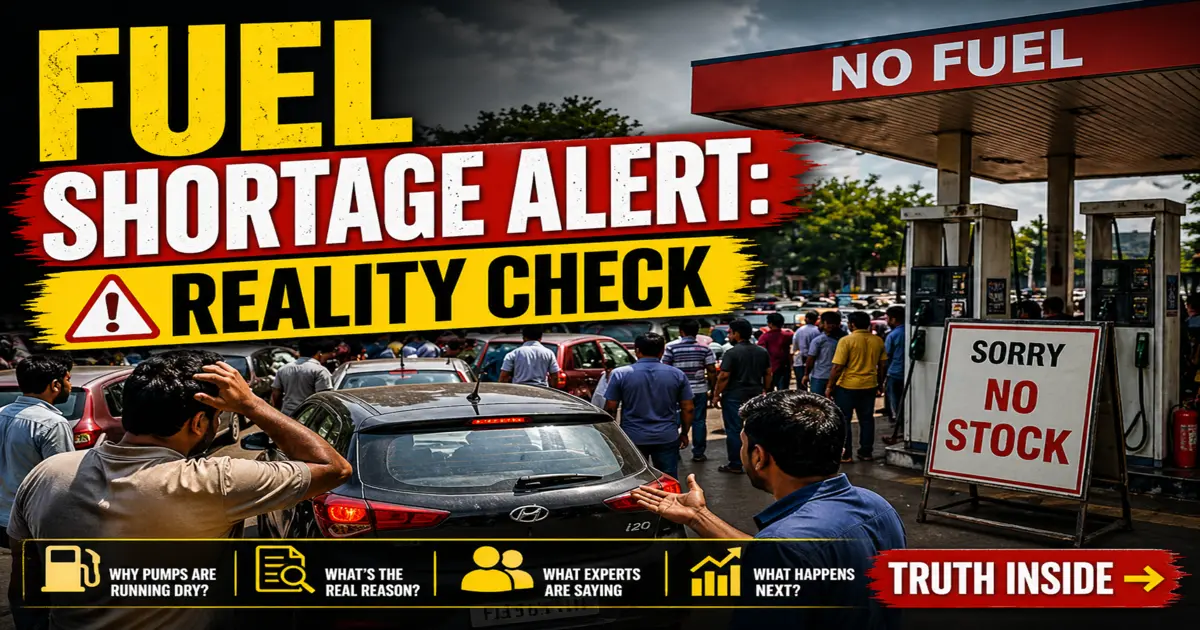
In recent days, several petrol pumps across multiple regions have displayed “No Stock” boards, leading to confusion and concern among the public. As these images and videos spread rapidly on social media, many people began to assume that the country might be facing a fuel shortage.
This perception quickly turned into panic in some areas, with people rushing to fuel stations to fill their tanks, further increasing demand and pressure on available supply points.
But here’s the important reality:
There is NO nationwide fuel shortage.
Fuel production, imports, and overall supply chains are functioning normally. The issue is not about the availability of fuel at the national level, but about temporary disruptions in how fuel is being supplied to individual petrol pumps.
In simple terms, this situation is caused by a change in the payment system, not a supply failure.
How the Fuel System Worked Earlier
To fully understand the current situation, it’s important to look at how the fuel distribution system functioned earlier.
For many years, petrol pumps operated under a credit-based supply system. Under this model:
- Fuel dealers received petrol and diesel from oil marketing companies (OMCs)
- Payments were made later, after the fuel was sold to customers
This system provided flexibility to petrol pump owners. Even if they did not have immediate cash in hand, they could continue operations smoothly. It ensured that pumps rarely ran out of stock due to financial constraints and maintained a steady flow of fuel supply to consumers.
This credit-based approach played a key role in keeping fuel availability consistent across urban and rural areas.
What Changed Now?
Recently, oil marketing companies (OMCs) introduced a significant operational change by shifting from the credit system to an advance payment model.
Advance Payment System:
- Dealers must make payment before placing an order
- Fuel is dispatched only after payment confirmation
This means that petrol pump owners now need to have sufficient funds ready before they can request new fuel supplies.
While this system improves financial discipline, it also requires dealers to adjust quickly to a new way of operating.
Main Reason Behind This Change
The decision to move to an advance payment system is primarily driven by financial and operational considerations.
The core objective:
To improve cash flow management and reduce financial risk for OMCsKey reasons include:- Increasing delays in payments from dealers
- Rising outstanding dues affecting company finances
- Need for better control over transactions
- Desire to reduce dependency on credit-based operations
By introducing advance payments, companies can ensure that every transaction is secured before fuel is dispatched, reducing uncertainty and improving financial stability.
In simple terms:
Credit system = flexibility but riskAdvance system = control but adjustment neededWhy “No Stock” Boards Are Appearing
The visible impact of this policy change is the appearance of “No Stock” boards at some petrol pumps.
However, this is not due to a shortage of fuel supply.
What is actually happening:- Dealers now need immediate funds to order fuel
- Some dealers are not fully prepared for this sudden shift
- Arranging funds and completing payments takes time
- Tanker dispatch is delayed until payment is confirmed
As a result, in certain cases, existing stock at petrol pumps gets exhausted before new supply arrives.
This is where a smart fuel management system like Petrosoft makes a real difference by providing complete financial clarity and control.
Result:
Fuel temporarily runs out at that location → “No Stock” board is displayed
This is a local and temporary issue, not a national-level shortage.
What Losses Are Happening?
This transition has created short-term challenges for multiple stakeholders.
For Petrol Pump Owners- Loss of daily revenue when fuel is unavailable
- Increased financial pressure due to upfront payments
- Need for higher working capital to maintain operations
- Longer waiting times at operational pumps
- Confusion due to unclear information
- Inconvenience in daily travel and commuting
- Sudden increase in demand in certain areas
- Temporary imbalance in fuel distribution
- Panic-driven purchasing behaviour
These impacts are temporary but noticeable during the transition phase.
Who Is Suffering the Most?
Not all groups are affected equally. Some segments are facing more pressure than others.
Small and Medium Fuel Dealers- Limited financial reserves
- Difficulty arranging immediate funds Most affected group
- Already dependent on slower supply chains
- Additional delays worsen the situation
- Face inconvenience due to sudden unavailability
- Affected by misinformation and panic
Where Did the Rumour Start?
The confusion around this issue did not start with the policy change itself, but with how it was perceived and shared.
How it began:- A few petrol pumps displayed “No Stock” boards
- Customers captured photos and videos
- Content was shared widely on WhatsApp, Facebook, and other platforms
Soon, messages began circulating claiming:
“Fuel shortage in India”
Why People Believed It
The rumour spread quickly due to several factors:
1. Lack of AwarenessMost people were unaware of the payment system change, so they assumed a supply problem.
2. Social Media AmplificationA small local issue quickly became a widespread concern due to rapid sharing without context.
3. Panic Buying- People rushed to fill fuel tanks
- Demand suddenly increased
- Nearby pumps actually ran out of stock faster
This created a cycle where rumor and reality started to overlap.
The Real Problem (In One Line)
This is not a fuel shortage — it is a temporary distribution delay caused by a payment system transition.
Reality Check| What People Think | Actual Reality |
|---|---|
| Fuel shortage in India | ❌ False |
| Petrol/Diesel finished | ❌ False |
| Supply stopped | ❌ False |
| Temporary delay due to payment change | ✅ True |
Final Conclusion
The current situation reflects a transition phase in the fuel distribution system. The shift from a credit-based model to an advance payment system has introduced short-term operational challenges for fuel dealers.
At the same time, misinformation and rapid social media sharing amplified the situation, creating unnecessary panic among the public.
What’s actually happening:
- Credit system has been replaced
- Advance payment system is being implemented
- Dealers are adapting to the new process
What was misunderstood:
- People assumed a nationwide fuel shortage