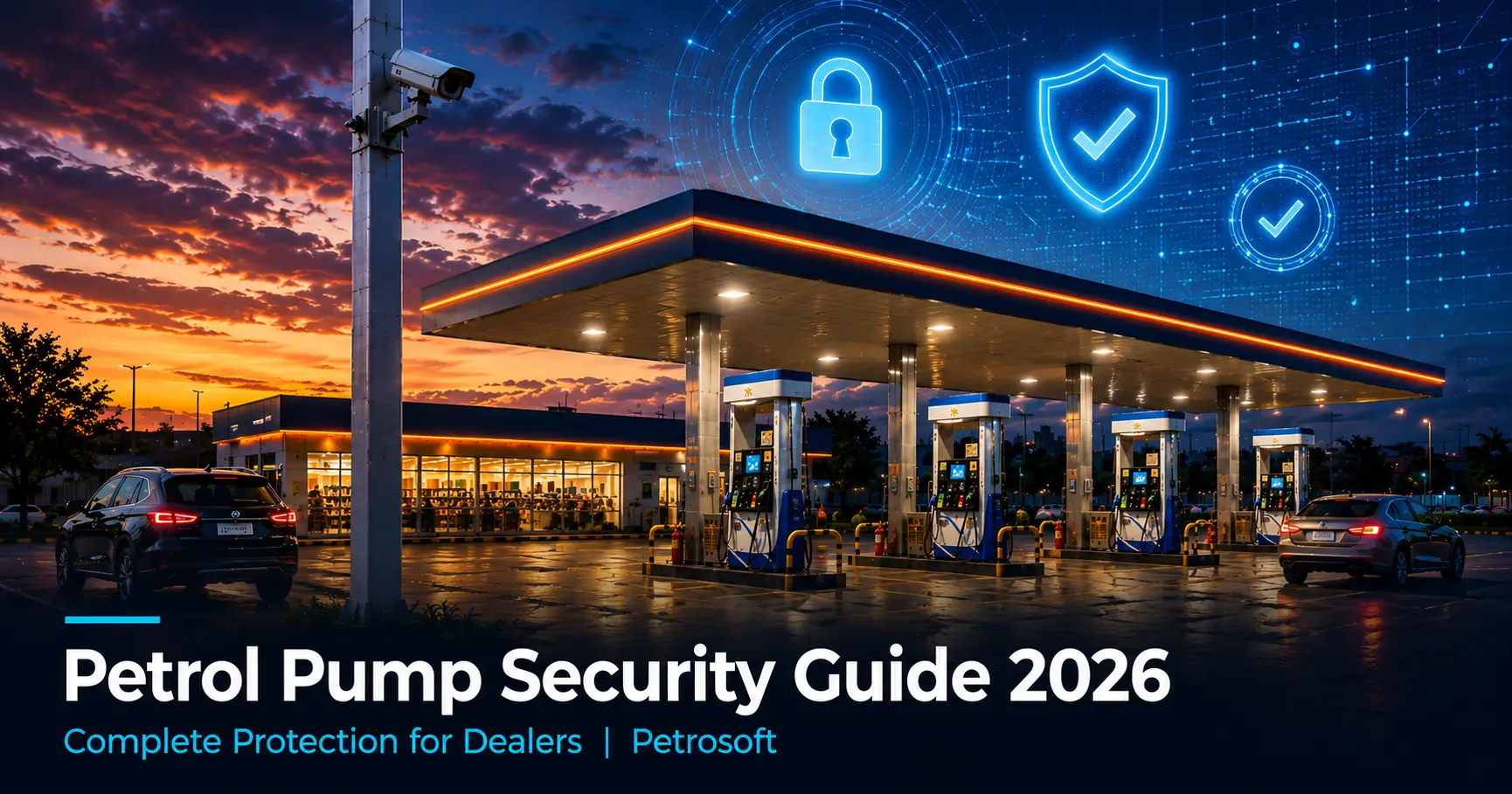
Petrol pump security has two dimensions physical security (fuel theft, cash handling, unauthorized access) and data security (digital records, transaction fraud, unauthorized system access). Whether you run a single outlet or a multi-outlet chain, losses from either side can quietly eat into your margins for months before you notice. This guide explains both risks in plain terms and shows how modern petrol pump management software protects dealers from both kinds of loss in one place.
What Is Petrol Pump Security?
Before diving into risks and solutions, it helps to understand the two sides of petrol pump security clearly.
What Is Physical Security in a Petrol Pump?
Physical security covers everything that can be seen, touched, or physically tampered with at your outlet fuel dispensers, underground tanks, cash drawers, and the pump premises itself. It answers the question: "Is my fuel, cash, and premises protected from theft or tampering?"
What Is Data Security in a Petrol Pump?
Data security covers everything digital sales records, transaction logs, employee access, and financial reports stored on your software or in the cloud. It answers the question: "Is my business data protected from unauthorized access, loss, or manipulation?"
Why Both Matter Together in 2026
As more petrol pumps in India adopt management software, dealer, manager, and salesman apps, the two risks now overlap. A dealer who secures fuel tanks but ignores who can access sales data or vice versa still has an open gap. Complete protection means addressing both together.
| Aspect | Physical Security | Data Security |
|---|---|---|
| What it protects | Fuel, cash, premises | Sales data, transactions, records |
| Common risk | Pilferage, tampering, theft | Unauthorized access, data loss, fraud |
| Who's responsible | On-ground staff, CCTV, locks | Software permissions, cloud backup |
| Solved by | Monitoring hardware + SOPs | Role-based software access |
Common Physical Security Risks at Petrol Pumps
1. Fuel Pilferage & Dispenser Meter Tampering
Dispenser meters are sometimes tampered with to deliver less fuel than billed. UP Police investigations found remote-controlled chips under-delivering at least 10% of fuel paid for, and Legal Metrology raids across states like Delhi and J&K show this remains a widespread problem. Even small shortfalls add up over time and the legal liability falls on the dealer.
2. Tank-Level Stock Mismatch & Fraud
When physical stock in underground tanks doesn't match recorded sales, it usually points to unrecorded sales, evaporation losses being misused as a cover, or deliberate under-reporting. Without automated tank monitoring, this mismatch often goes unnoticed until the losses are substantial.
3. Cash Handling Theft by Employees
Cash-heavy operations are naturally vulnerable. Employees handling daily collections may under-report sales, delay cash deposits, or pocket small amounts across multiple transactions a pattern that's hard to catch manually, especially across multiple shifts and outlets.
4. Unauthorized Access During Night Shifts
Night hours typically have fewer staff and less supervision, making them a common window for both fuel theft and unauthorized entry into restricted areas like the cash office or tank room.
5. CCTV & Surveillance Gaps
Many outlets install CCTV but don't monitor footage in real time or maintain it consistently. Blind spots near dispensers, tank rooms, or cash counters remain a persistent vulnerability.
6. Common Data Security Risks for Digitized Petrol Pumps
As dealers move from paper registers to digital systems, new risks emerge less visible but equally damaging. IBM's 2025 report found the average data breach cost in India hit ₹22 crore, up 13% YoY, with phishing and stolen credentials as top causes. A petrol pump doesn't need to be a large enterprise to face the same risks one unsecured login is enough.
7. Unauthorized Access to Sales & Financial Data
When every user dealer, manager, salesman, or pump boy has the same level of access, sensitive information like profit margins, bank details, and full financial reports becomes visible to staff who only need daily sales figures. This is a data exposure risk that most first-time software users don't anticipate.
8. Data Leakage Across Multiple Outlets
For dealers running more than one outlet, this risk is especially critical: without proper data isolation, a manager at one outlet may end up viewing sales or financial data belonging to a different branch a serious concern for multi-outlet petrol pump chains.
Digitization is simply a tool when the software is properly designed, every one of these risks can be controlled and monitored, rather than discovered after the damage is done.
How Petrosoft Software Protects Both Physical & Data Security
1. Real-Time Tank Monitoring & Automated Meter Reading
Automated tank gauges and meter integration remove the manual entry point where tampering typically happens, giving dealers real-time visibility into stock vs. sales.
2. Role-Based Access Control Across Petrosoft's Mobile Apps
Instead of one app with one login for everyone, Petrosoft's suite of mobile apps splits access across separate, role-specific apps so each person only ever sees the data their job actually requires. This is what closes the "everyone sees everything" gap discussed earlier.
Petrosoft Dealer App: Built for owners, this app gives a complete, real-time view of the business: bank, cash and credit transactions, live inventory, collections from credit customers, payables to vendors, and permission-based access control over what every other user can see or edit. It's the only app in the ecosystem with full financial visibility.
Petrosoft Manager App: Designed for outlet managers, this app handles day-to-day operations without exposing full ownership-level financials: staff attendance, automated payroll calculation, shift-wise business closing, shortage reports, and GST-ready statements all at the outlet level.
Petrosoft DSM App(Salesman & Pump Boy): Built for on-ground staff, this app is limited to exactly what a shift worker needs: recording cash and credit sales during a shift, nozzle and lubricant assignment, fuel density readings, and shift-closing worksheets that are verified before submission. Staff can't view outlet-wide financials or other employees' records only their own shift data.
Petrosoft Credit User App: A separate, restricted-access app for the pump's credit customers, not staff. It lets registered credit customers view only their own vehicle-wise purchase history, statements, and bills with no visibility into the pump's internal operations at all.
Because each app is scoped to a specific role from the ground up, a salesman logging into the DSM app simply has no way to see dealer-level financials the access boundary is built into the software itself, not left to manual permission settings that can be forgotten or misconfigured.
3. Cloud Backup & Encrypted Transaction Records
All transaction data is backed up to the cloud automatically, removing dependency on a single device or local server, and reducing the risk of permanent data loss.
4. Shift-Wise Reconciliation & Audit Trail Reports
Every entry is timestamped and tied to a specific user, making it easy to spot discrepancies by shift, employee, or outlet closing the door on backdated or fake entries.
5. Multi-Outlet Data Isolation for Chain Owners
For dealers managing multiple outlets, data is segmented by outlet, ensuring managers and staff at one location cannot view data belonging to another a core requirement covered in our Multi-Outlet Petrol Pump Chain Management guide.
Physical + Data Security Checklist for Petrol Pump Owners (2026)
- Install automated tank monitoring to eliminate manual stock discrepancies
- Set up dispenser meter calibration checks on a fixed schedule
- Use role-based software access for every employee level
- Enable automatic cloud backup for all transaction data
- Maintain shift-wise reconciliation reports, not just end-of-day totals
- Review CCTV footage regularly, not just after an incident
- Restrict night-shift access to cash office and tank areas
- Isolate outlet-wise data if you operate more than one pump
- Maintain an audit trail for every sales entry and edit
- Conduct periodic security audits both physical and digital