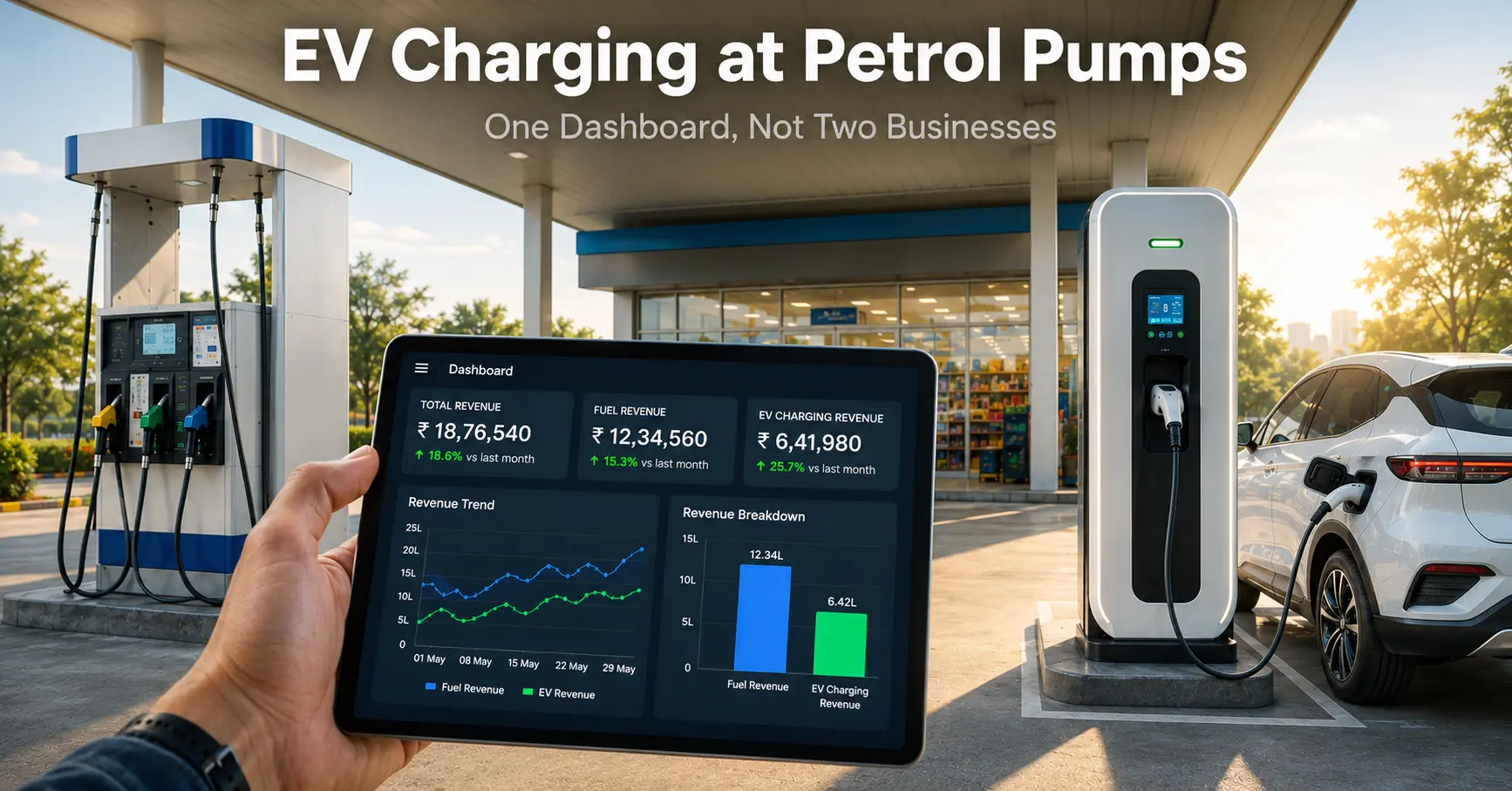
Petrosoft HPCL, IOCL, and BPCL are pushing EV charging onto petrol pump forecourts across India through state mandates, national subsidy schemes, and network-level rollout targets. For dealers, this is no longer a diversification you opt into; it's an operational requirement arriving on a timeline you don't control. The real risk isn't the charger itself it's running fuel and EV charging as two disconnected businesses instead of one. This article lays out why the mandate is arriving now, what breaks operationally when charging is bolted on separately, and how a single dashboard fixes it.
Why EV Charging Is Arriving at Your Outlet Right Now
This isn't a trend dealer are choosing to follow it’s a push coming from three directions at once, all landing on the same forecourt at the same time.
OMCs are setting the pace
IOCL, BPCL, and HPCL have committed to large-scale EV charging rollouts across their retail networks, and that commitment flows down to individual outlets as a network requirement, not a local choice. India had roughly 29,000 public EV charging stations by early 2026, up from about 5,000 in 2022 a near six-fold increase in three years. Ministry data tabled in Parliament puts installed stations at 27,737, with 22,753 operational, as of March 2026, and OMC-branded forecourts account for a growing share of that build-out.
State mandates are turning this into a compliance requirement
Several states have moved from encouragement to mandate:
| State | Requirement |
|---|---|
| Maharashtra | Mandatory: at least one EV charger per petrol pump |
| Kerala | Mandatory: at least one EV charger per petrol pump |
| Tamil Nadu | Mandatory: at least one EV charger per petrol pump |
| Delhi | Fast chargers targeted every ~5 km citywide, with subsidies |
| National Highways (NHAI) | Charging points every 40–60 km, extending to state highways in several states |
If your outlet sits in a mandate state or on an OMC's priority rollout list, this has already shifted from a future decision to a compliance deadline and acting ahead of enforcement is cheaper than retrofitting under pressure.
Subsidies remove the biggest cost barrier
The PM E-DRIVE scheme subsidizes up to 80% of upstream power infrastructure costs for eligible public charging projects, with support planned across 50 national highway corridors. States layer concessional land rates, EV-specific power tariffs, and tax rebates on top. Because a working petrol pump already has land and a grid connection, the largest cost barrier a fresh EV-only operator would face is already solved for you.
The Real Problem: Two Businesses, One Outlet
The hardware isn't the hard part. Once a charger is live, most dealers end up running fuel and EV charging as two disconnected businesses separate apps, separate reports, no combined view of profitability, and no visibility into charger uptime. In practice, this shows up as:
- • A charging-network app that has nothing to do with the pump's own fuel- sales system
- • No single report that shows outlet profitability once power costs, AMC, and charger downtime are factored in
- • Attendants trained to dispense fuel but not to handle charging sessions or basic fault triage
- • Two separate reports reaching the owner fuel and charging that rarely reconcile cleanly
- • No alert when a charger goes offline, so it can sit unused for days before anyone notices
A meaningful share of India's installed public chargers are reported non-functional at any given time. Without uptime visibility, a charger stops being a revenue asset and becomes a sunk cost nobody is tracking. This is a software and process problem, not a technical one and it's solvable without adding a separate team.
How Petrosoft Puts Fuel and EV Charging on One Dashboard
Petrosoft's cloud-based petrol pump software already gives owners real-time visibility into fuel sales, stock, and staff performance across every outlet. As chargers go live, EV session data, uptime, and revenue extend into that same real-time layer so checking outlet performance means one screen, not two reports that need manual cross-checking.
One set of role-based apps, not a second system
Petrosoft's four apps Dealer, Credit Customer, Manager, and DSM already split responsibility by role. That structure extends naturally to a multi-energy forecourt:
- • Dealer app — consolidated performance across every outlet and every energy type in one place
- • Manager app — combined fuel + charging revenue per shift, so reconciliation happens once
- • DSM app — field and outlet-level monitoring extended to charger uptime and session activity
- • Credit Customer app — fleet and corporate customers see EV charging spend on the same statement as fuel spend
Attendance and payroll extend to new roles
As charging bays go live, some staff take on new duties monitoring sessions, handling customer queries, basic fault escalation. Automated, shift-based attendance and payroll systems already built for fuel-pump staff extend cleanly to these roles instead of requiring a separate HR process for the charging side.
Uptime tracking protects the revenue you already paid to install
Bringing charger status into the same dashboard used for fuel stock and pump health means a fault gets flagged and resolved as part of routine outlet management not discovered a week later when a customer complains.
Rollout Checklist for Multi-Outlet Dealers
If you're rolling out chargers across more than one outlet, sequencing matters more than speed:
- • Standardize reporting before hardware. Decide how charging revenue, uptime, and session data will be tracked before chargers go live everywhere.
- • Prioritize by mandate + footfall. Mandate-state outlets carry a compliance deadline; high-highway-traffic outlets carry the strongest ROI — sequence accordingly.
- • Pilot at one outlet first. Validate attendant workflow, manager reconciliation, and owner reporting before scaling chain-wide.
- • Track charging as its own P&L line. Folding it into "other income" makes it impossible to judge whether a charger is actually paying for itself.
Conclusion:
EV charging is becoming an essential part of the modern petrol pump business. Dealers who manage fuel and EV charging through one unified dashboard can improve operational visibility, track revenue and charger uptime, and scale more efficiently. Talk to Petrosoft todayto manage your fuel and EV charging operations from one dashboard and prepare your outlet for the future.