

What Are the New Labour Codes?
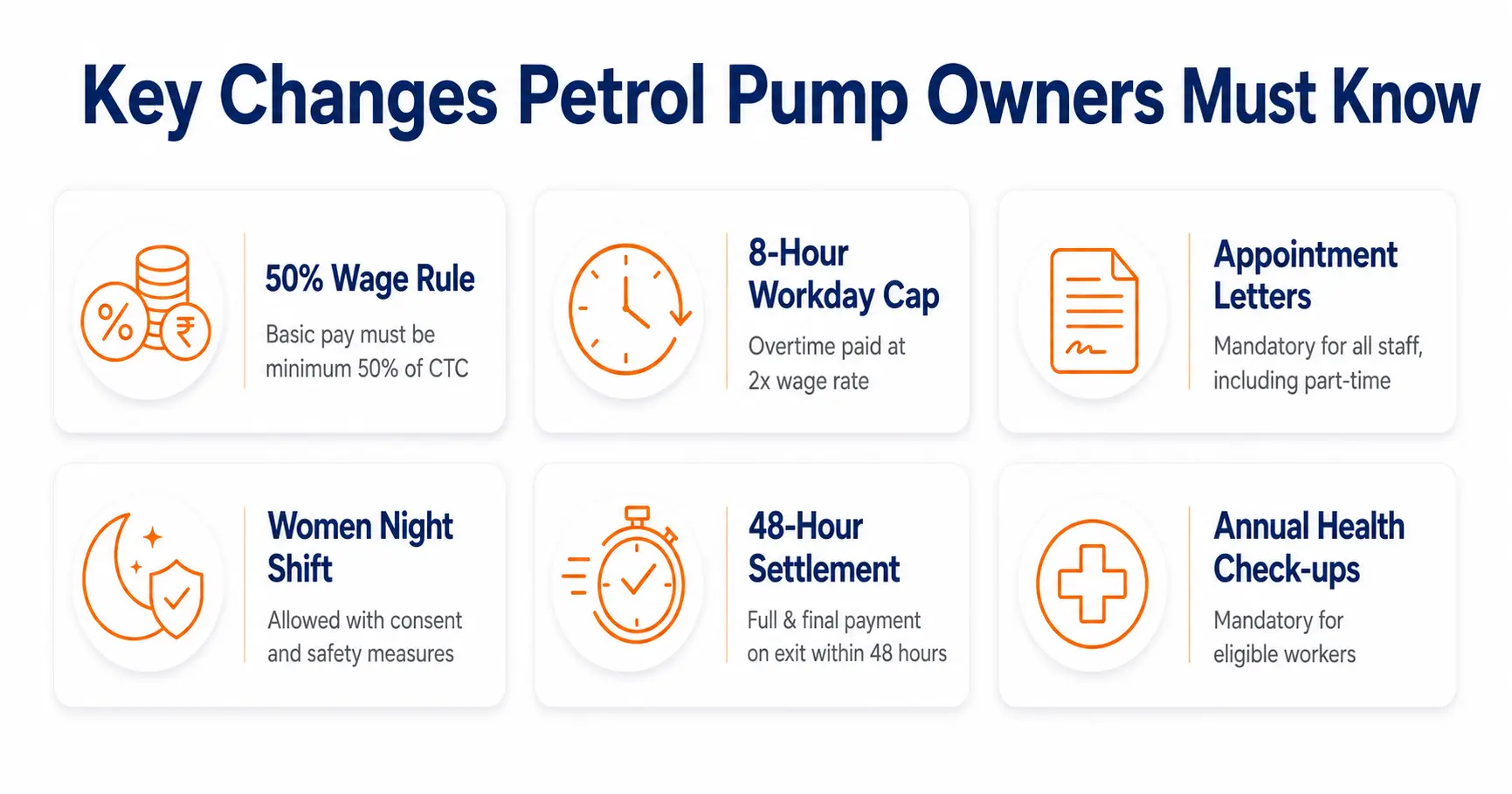
Key Changes Petrol Pump Owners Must Know
The Real Problem: Manual Systems Can't Keep Up
India's employment law has undergone its biggest overhaul since Independence. Twenty-nine separate labour laws have been consolidated into four unified Labour Codes the Code on Wages, the Industrial Relations Code, the Code on Social Security, and the Occupational Safety, Health and Working Conditions Code. These were notified by the Ministry of Labour and Employment on November 21, 2025, with final central rules published on May 8, 2026, and enforcement rolling out progressively across states through 2026.
For most industries, this is a back-office HR matter. For petrol pump owners, it's far more direct because fuel stations run on shift-based, round-the-clock staff, and nearly every major change under the new code’s touches shift scheduling, wages, or staff records in some way. This is where petrol pump management software like Petrosoft becomes essential, helping owners stay compliant without adding manual workload to their daily operations.
What Are the New Labour Codes?
The Government of India consolidated 29 old labour laws into 4 unified Labour Codes the Code on Wages, the Industrial Relations Code, the Code on Social Security, and the Occupational Safety, Health and Working Conditions Code. These were notified on November 21, 2025, with final central rules published on May 8, 2026, and rollout continuing across states through 2026.
QUICK FACT
India's Labour Codes are now the biggest employment law reform since Independence but full compliance isn't uniform yet. Since Labour is a Concurrent Subject under the Constitution, each state must separately notify its own rules before enforcement is complete. Some states have already done so; others are still in progress meaning compliance requirements can vary depending on where your petrol pump is located.
Why Petrol Pumps Are Especially Affected
Unlike a typical office business, a petrol pump operates in continuous shifts, employs multiple attendants and cashiers, and often runs with thin administrative support. Compliance here isn't a once-a-year HR exercise it needs to be tracked daily, shift by shift. That makes petrol pumps more exposed than most small businesses to the operational side of these reforms.
1. The 50% Wage Rule
Under the new Code on Wages, basic pay must now account for at least 50% of an employee's total compensation (CTC). This directly increases statutory contributions like Provident Fund and Gratuity for most employers including petrol pump staff on fixed monthly pay.
| What Changed | Old Rule | New Rule (2026) |
|---|---|---|
| Basic Pay as % of CTC | No minimum (often 20–30%) | Minimum 50% of CTC |
| PF Calculation Base | Only on low basic pay | On higher wage base (50%+ of CTC) |
| Gratuity Calculation Base | Only on basic + DA | On higher redefined wage base |
| Monthly Take-Home | Higher (less PF deducted) | Slightly lower (more PF deducted) |
| Retirement Savings (PF + Gratuity) | Lower | Significantly higher |
2. 8-Hour Workday Cap & Overtime
Working hours are capped at 8 hours per day, with any work beyond that classified as overtime and paid at 2x the normal wage rate. For petrol pumps running 24-hour operations, this means shift plans need to be restructured carefully to avoid unplanned overtime costs.
3. Mandatory Appointment Letters
Every employee including part-time attendants and shift workers — must now receive a formal appointment letter. Earlier, this requirement applied only to specific "scheduled" employments; now it applies across all industries.
4. Women Night Shift Provision
Women can now be rostered for night shifts (7 PM to 6 AM), provided they give explicit consent and the employer ensures a safe working environment, including secure transport and adequate facilities. This opens up flexibility for pumps that previously restricted night shifts to male staff only.
5. 48-Hour Full & Final Settlement
When a staff member exits, final wage settlement must now be completed within 48 hours — a sharp reduction from the weeks-long timelines many businesses previously followed informally.
6. Annual Health Check-ups
The Occupational Safety, Health and Working Conditions Code mandates annual health check-ups for workers above a prescribed age relevant for petrol pumps with long-serving staff.
Most petrol pumps still track staff shifts, attendance, and wages through registers or basic spreadsheets. Under the new rules, that approach creates real risk:
A single missed overtime calculation or a delayed settlement can turn into a compliance issue something manual systems simply aren't built to catch in time.
Petrosoft's petrol pump management software includes a dedicated staff and shift management module designed to handle exactly these compliance points without adding manual workload:
Instead of owners manually cross-checking registers against new legal requirements, the system handles the tracking in the background while owners focus on running the pump.
The new Labour Codes aren't just a policy update for large corporations they directly reshape how petrol pumps schedule shifts, calculate wages, and manage staff records. For a business that runs on round-the-clock operations, staying compliant manually is a growing risk. Petrosoft petrol pump management software gives owners a much safer, more accurate way to adapt to these changes tracking shifts, wages, and staff documentation automatically, so compliance never depends on manual registers or last-minute checks.
Want to see how Petrosoft staff and shift management module keeps your petrol pump compliant with the new Labour Codes? Request a free demo today.
 Software
 Software
 Software
 Software
 Software
 Software
 Software
Software
 Software
 Software
 Software
 Software
 Software
 Software
 Software
 Software
 Software
 Software
 Software
 Software
 Software
 Software
 Software
 Software
 Software
 Software
 Software
 Software
 Software
 Software
 Software
 Software
 Software
 Petrosoft
 Software
Petrosoft
 Software
Petrosoft
 Software
Petrosoft
 Software
Petrosoft
 Software
Petrosoft
 Performance
Petrosoft
 Performance
Petrosoft
 Performance
Petrosoft
 Performance
Petrosoft
 Performance
Petrosoft
 Performance
Petrosoft
 Mobile App
Petrosoft
 Software
Petrosoft
 Software
Petrosoft
 Software
Petrosoft
 Software
Petrosoft
 Software
Petrosoft
 Software
Petrosoft
 Software
Petrosoft
 Software
Petrosoft
 Software
Petrosoft
 Sales
Sales
Petrosoft
 Software
Petrosoft
 Technology
Petrosoft
 Feedback
Petrosoft
 Marketing
Petrosoft
 Revolution
Petrosoft
 Software
Petrosoft
 Tips
Tips
Petrosoft
 Case Studies
Petrosoft
 Trends
Petrosoft
 Application
Petrosoft
 Application
Petrosoft
 Application
Petrosoft
 Operations
Petrosoft
 Operations
Petrosoft
 Sales
Sales
Petrosoft
 Sales
Sales
Petrosoft
 Application
Petrosoft